Couples planning Destination Weddings at Umaid Bhawan Palace often come in with a visual in mind — the sandstone facade, the sweeping driveway, the scale. What they don't always anticipate is how many of the most memorable moments come from the intersection of the palace's physical layout and experiences that only work in this specific setting. Some of these are curated add-ons. Others are just what happens when you hold a wedding inside a building this old, this large, and this specific to one place.
The Royal Baraat on the Palace Driveway
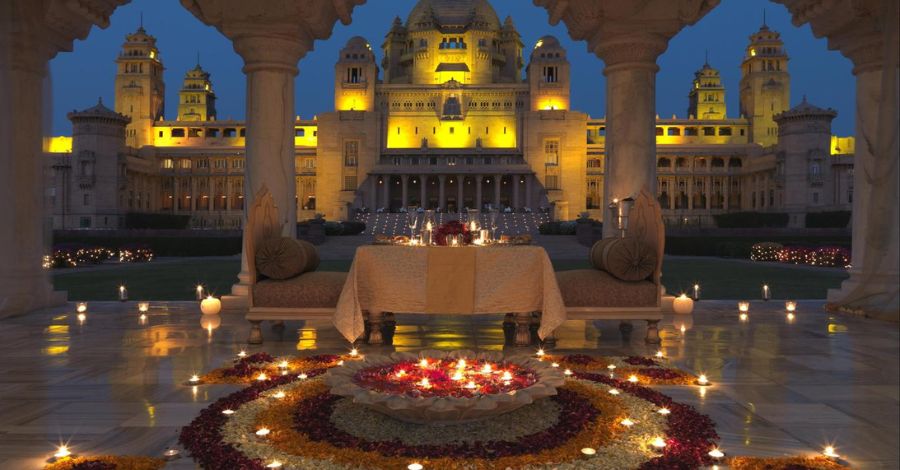
Umaid Bhawan's main driveway is roughly 400 metres from the palace gates to the entrance portico. No other wedding venue in Rajasthan has an arrival road at this scale that is also part of the event property. For a Royal Wedding in Jodhpur's Umaid Bhawan Palace, the baraat procession uses the full length of it — dhol players, brass band, family dancing, the groom on horseback or in a vintage car — with the palace elevation rising ahead the entire time.
The driveway width also means the procession doesn't compress into a single-file shuffle. There is room for the baraat to spread, which changes how it photographs and how it feels for guests walking alongside. Most venues with a "royal baraat" option are working with 80 metres of usable path. Here it is a genuine procession.
Timing matters. Evening baarats timed to blue hour — roughly 6:15 to 6:45 pm between October and February — catch the sandstone turning from gold to amber as the palace lights come up. It is not something a lighting vendor manufactures. It is just the building at that hour.
Private Mehrangarh Fort Access for Pre-Wedding Functions
Mehrangarh Fort sits 4 km from Umaid Bhawan on a 125-metre rock outcrop above Jodhpur's old city. It is one of the largest forts in India and, unlike many heritage sites in Rajasthan, still actively managed by the Jodhpur royal family's trust — the same family whose residence you are booking for the wedding.
That relationship matters when it comes to access. Private evening buyouts of sections of the fort — the Sheesh Mahal, the Phool Mahal, the ramparts overlooking the blue city — are arrangeable for cocktail functions or pre-wedding shoots in a way that is not available to general visitors. A sunset cocktail on Mehrangarh's ramparts with Jodhpur's blue rooftops below is not replicable at any other Umaid Bhawan Palace Wedding, or at any other venue in the country for that matter.
Pre-wedding shoots at the fort, typically arranged for the morning before the main wedding day, produce a visual range that the palace grounds alone cannot — the narrow lanes of the old city below the fort walls, the carved sandstone interiors, the panoramic views across to Umaid Bhawan itself in the distance.
The Durbar Hall Sangeet
Most outdoor sangeet setups at Indian weddings involve a stage, a dance floor, and a tent or shamiyana overhead. The Durbar Hall at Umaid Bhawan is a different proposition. Art Deco interiors from the 1940s, ceiling heights that handle concert-level sound production without it becoming noise, and original palace furnishings that no event decorator can source or replicate.
For couples who want the sangeet to feel different from every other sangeet their guests have attended, the Durbar Hall does that without any additional theming effort. The room is already doing the work. What a planner adds on top — lighting, floral placement, stage design — is layered onto a base that is genuinely distinctive rather than a blank-canvas tent.
The practical consideration: the Durbar Hall has a fixed capacity and a specific load-in protocol. It is not a flexible space. Sangeet setups here require earlier production timelines than outdoor functions, and the Taj events team has approval requirements for what goes in. It is manageable, but it needs to be built into the schedule from the start.
Vintage Car Arrivals and the Palace Motor Collection
Umaid Bhawan Palace has its own vintage car collection, including several vehicles from the Jodhpur royal family's historical fleet. For wedding arrivals — the bride's doli entry, the groom's baraat, or a couple's exit after the reception — the option to use a period-correct vehicle from the palace's own collection rather than a rented prop changes the register of the moment entirely.
These are not museum pieces dressed up for events. They are part of the palace's operational heritage and have been used for ceremonial occasions for decades. The visual difference between arriving in a rented vintage car and arriving in a vehicle that is documented as part of the venue's own history is something guests notice, even if they can't articulate why.
Availability and access to specific vehicles needs to be confirmed during the planning stage — not all cars are available for all events, and the logistics of integrating them into a ceremony timeline require coordination with the palace administration separately from the Taj events team.
Falconry and Traditional Rajput Ceremonial Elements
The Rajput royal tradition includes ceremonial elements that are rarely available at hotels or resort venues because they require both the right physical setting and access to practitioners who understand the cultural context. At Umaid Bhawan, arrangements for ceremonial falconry — handlers from Jodhpur's traditional falconry community, birds trained for display rather than hunting — are possible as part of the pre-wedding welcome or the baraat reception.
It reads as spectacle from a distance. Up close, for guests who engage with the handlers and the birds, it is a genuine introduction to a practice that the Rajput nobility maintained for centuries. For destination weddings with a significant proportion of international guests, it is the kind of experience that gives the wedding a specific cultural texture rather than generic Rajasthan decor.
Turban-tying ceremonies, customary Rajasthani welcome rituals performed by practitioners from Jodhpur rather than event staff in costume, and traditional folk music ensembles from the Manganiyar and Langa communities of western Rajasthan — all of these are sourceable in Jodhpur in a way they are not in cities further from the region's cultural core.
Sunrise and Golden Hour Photography on the Palace Grounds
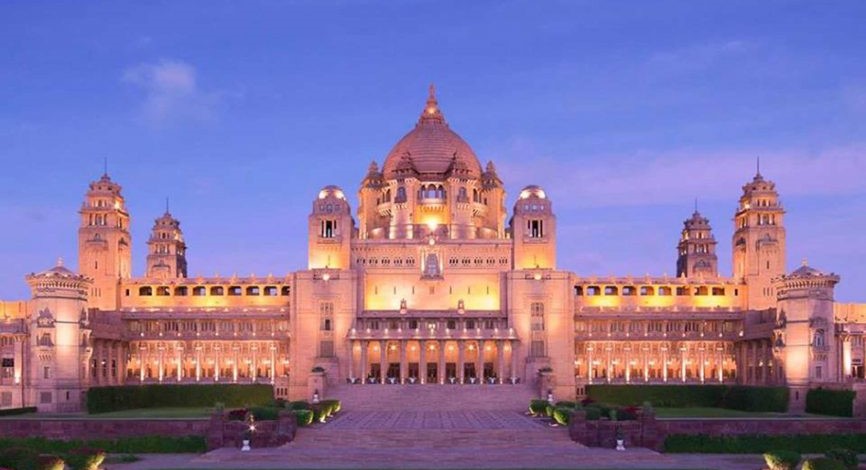
Umaid Bhawan's sandstone construction uses Chittar stone, a local buff-coloured stone that changes colour across the day more dramatically than most building materials. Early morning light between 6:30 and 8:00 am turns it pale gold. Late afternoon light from 4:00 pm onward deepens it to amber and then to near-orange as the sun drops. Both windows produce photographs that do not require filters, backdrops, or post-processing to look the way they look.
For pre-wedding shoots scheduled on the morning of the wedding day or the day before, the palace grounds are relatively quiet in the early hours. The Marigold Lawn without event furniture, the palace's arched corridors, the formal gardens on the eastern side — these spaces look different at 7:00 am than they do during the event itself, and a photographer who knows the building uses both.
The rooftop terraces and upper-floor corridors within the heritage wing are accessible for shoots with advance coordination. These elevations produce the full Jodhpur skyline — Mehrangarh Fort, the blue city rooftops, the Thar Desert's flat horizon to the west — within a single frame.


No comments:
Post a Comment